When Knee Bracing Helps Rehab (and When It Creates a Crutch)
Knee Injuries
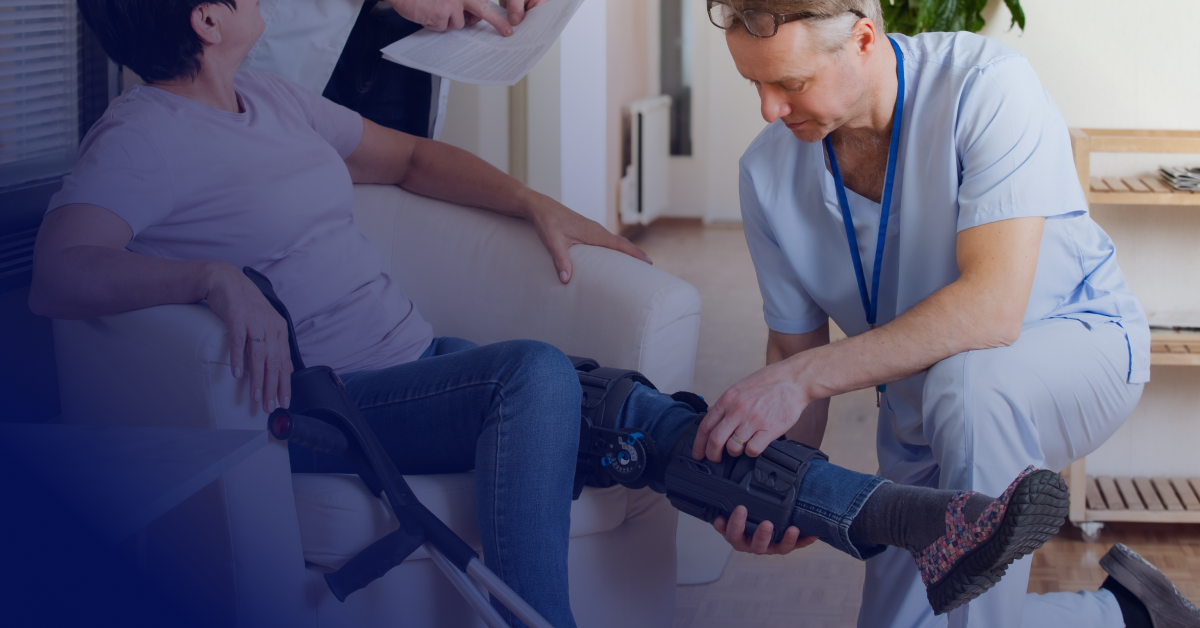
Knee braces can be useful. They can protect a healing ligament, help control unwanted movement, reduce symptoms during certain activities, or give a patient enough support to begin moving more comfortably.
The problem starts when the brace becomes the treatment instead of part of the treatment.
In physical therapy, we are usually trying to restore what the knee needs to do on its own: move through an appropriate range of motion, produce and absorb force, maintain balance, respond to changes in direction, and tolerate the demands of everyday life or sports. A brace may help us get there, but it cannot rebuild muscle strength, improve neuromuscular control, or complete the rehabilitation process for you.
Whether you should wear one depends on why your knee hurts, what structure is injured, and what role the brace is supposed to play during recovery.
A Knee Brace Should Have a Specific Job
There is a major difference between wearing a brace because your physical therapist or physician wants to protect a healing ligament and pulling on a compression sleeve because your knee feels vaguely uncomfortable.
Different knee supports are designed to do different things. A hinged brace can restrict certain side-to-side forces after a ligament injury. An offloader brace can change how pressure is distributed through an arthritic knee. A patellar-stabilizing brace may be used for certain kneecap-instability problems. A basic sleeve primarily provides compression and a feeling of support.
That is why “Should I wear a knee brace?” is difficult to answer without first knowing the diagnosis.
Our companion article from New York Bone & Joint Specialists, Do Knee Braces Actually Work? An Orthopedic Surgeon's Take, explains how orthopedic specialists determine which types of knee problems may benefit from bracing. From the physical therapy side, the next question is what happens once that brace becomes part of rehabilitation.
When Bracing Can Be Helpful During Rehab
Bracing makes the most sense when we can clearly explain what the brace is accomplishing and how that function supports the current phase of recovery.
Protecting a Healing Ligament
Medial collateral ligament, or MCL, injuries are a common example. Many isolated MCL injuries can be treated without surgery, and hinged bracing is frequently incorporated into rehabilitation depending on the severity of the injury. [1]
The brace can help limit stresses that place excessive strain on the healing ligament while still allowing controlled knee movement. This creates an opportunity to begin restoring motion, muscle function, and walking mechanics without simply immobilizing the entire joint.
The important word is controlled. The brace does not make the ligament instantly healthy. It helps create an environment in which appropriate movement can occur while the tissue heals.
As recovery progresses, the rehabilitation program should gradually ask more of the knee rather than relying indefinitely on the brace to provide stability.
Allowing Movement While Protecting a Vulnerable Knee
One of the goals of modern rehabilitation is often to avoid unnecessary prolonged immobilization.
When medically appropriate, a brace can allow movement within a safe range rather than requiring the knee to remain completely still. That matters because rehabilitation itself depends on progressively restoring motion, strength, and function.
For example, a physician may prescribe a brace with specific range-of-motion restrictions after certain injuries or surgical procedures. Physical therapy then works within those restrictions and progresses according to the surgeon's protocol and the patient's recovery.
This is very different from independently deciding that your knee needs to remain braced and protected because movement makes you nervous.
Improving Confidence During an Early Phase of Recovery
After an injury, some patients are understandably hesitant to trust the knee again. A brace can sometimes provide enough external support or reassurance to help someone begin walking or performing prescribed exercises more comfortably.
That can be useful early on.
But confidence eventually needs to come from the knee's improving capacity, not only from having something wrapped around it. Strength, balance, coordination, and repeated successful movement are what allow the nervous system and the patient to regain trust in the injured leg.
A brace can help open that door. Rehabilitation still has to take you through it.
When Does a Brace Start Becoming a "Crutch"?
A knee brace does not literally become a crutch, and simply wearing one does not automatically weaken your knee.
The problem is overreliance.
If you continue using a brace because you have not restored the strength, movement, balance, or confidence needed to function without it, the brace may begin hiding a rehabilitation gap rather than solving one.
This can show up in several ways. Maybe you can exercise only when the brace is on. Perhaps you avoid increasing resistance because the knee still feels vulnerable. You may automatically reach for the brace before any physical activity even though your clinician has told you it is no longer required.
In those situations, the question becomes less about the brace and more about why you still feel dependent on it.
A Brace Cannot Rebuild Your Quadriceps
Knee injuries commonly affect muscle function, particularly the quadriceps. Pain, swelling, surgery, and decreased activity can all make it harder to regain normal strength.
A knee brace cannot reverse that.
Rehabilitation may include progressive exercises such as squats, step-ups, split squats, leg presses, knee-extension exercises, hamstring strengthening, and other movements selected according to the injury and phase of recovery.
The resistance, range of motion, volume, and complexity should change as the knee improves. Eventually, an athlete may progress into running, jumping, landing, cutting, and sport-specific work when those activities are appropriate.
That progression is what builds the knee's ability to manage force. A brace may accompany part of the process, but it cannot substitute for it.
Bracing Cannot Replace Balance and Neuromuscular Training Either
Your knee does more than bend and straighten. During sports and everyday movement, the nervous system constantly adjusts muscle activity as you step off a curb, land from a jump, change direction, or recover from an unexpected movement.
Rehabilitation therefore includes more than basic strength.
Balance, proprioception, coordination, and neuromuscular exercises may become increasingly important as recovery progresses. Current clinical guidance for ACL rehabilitation and knee-injury prevention emphasizes exercise-based neuromuscular training rather than relying on external bracing to restore or protect function. [2][3]
A patient may look strong during a controlled exercise but still struggle with a single-leg landing or quick change in direction. A brace cannot correct that movement pattern by itself.
Those are rehabilitation problems, not brace-selection problems.
What About Wearing a Brace After ACL Surgery?
This is one of the clearest examples of why more support is not necessarily better.
Some patients expect to receive a functional knee brace before returning to activity after ACL rehabilitation. It seems logical that an external brace would provide additional protection to the reconstructed ligament.
However, current American Academy of Orthopaedic Surgeons guidance does not recommend routine functional bracing after an isolated primary ACL reconstruction because available evidence has not demonstrated a clinical benefit. [2]
That does not mean every patient has exactly the same postoperative plan. Additional ligament injuries, meniscus procedures, surgeon preference, and other clinical circumstances can affect bracing instructions.
What it does mean is that the brace should not become the factor that determines whether an athlete is ready to return.
Strength, movement quality, functional testing, psychological readiness, and sport-specific capacity are far more important parts of that decision.
Return to Sport Cannot Be Determined by Whether the Brace Feels Good
A brace can create a sense of security. That feeling can be valuable, but it is not the same as demonstrating readiness for competition.
An athlete returning after a significant knee injury needs to tolerate the actual demands of the sport. Depending on the injury, rehabilitation may evaluate single-leg strength, hopping ability, landing mechanics, balance, change of direction, running tolerance, and other functional measures.
Current ACL guidance supports functional evaluation, including measures such as hop testing, as one component of return-to-sport decision-making. [2]
Putting on a brace and saying, “It feels stable now,” does not answer those questions.
This is the same principle we use throughout return-to-sport rehabilitation. Clearance should be based on what the athlete can actually do, not simply how much time has passed or how secure the knee feels inside a brace.
What About Knee Osteoarthritis?
Bracing can also be used for a completely different reason in people with knee osteoarthritis.
An offloader or unloading brace is designed to shift some force away from a more affected part of the knee. Recent randomized research continues to evaluate bracing as an addition to education and exercise for people with compartment-specific knee osteoarthritis, reflecting the fact that bracing can be useful but is generally considered alongside active management rather than as a replacement for it. [4]
Physical therapy for knee osteoarthritis commonly focuses on improving strength, mobility, walking capacity, and overall function. Exercise programs have been shown to improve pain and strength in people with knee osteoarthritis. [5]
If a brace makes it easier to walk or exercise with less discomfort, it may help a patient participate more fully in rehabilitation. That is a useful role.
If the patient stops strengthening because the brace makes daily activity tolerable enough, an opportunity has been missed.
Patellar Bracing Is Also Diagnosis-Specific
Pain around the kneecap is another area where patients frequently arrive at physical therapy already wearing a sleeve, strap, or stabilizing brace.
Some patients with patellar instability may use bracing during conservative rehabilitation. Reviews of first-time patellar dislocation management describe bracing alongside range-of-motion work and neuromuscular exercise as commonly used components of treatment. [6]
But not every case of front-of-knee pain involves instability.
Patellofemoral pain can be related to a different set of contributing factors, and rehabilitation commonly emphasizes exercise addressing the hip and knee rather than assuming that a brace is necessary.
Again, the diagnosis determines the role of the brace.
How Physical Therapists Decide When to Reduce Brace Use
There is no universal week when every patient should stop wearing a knee brace.
The decision depends on the injury, healing restrictions, physician instructions, symptoms, and how the knee is functioning. A therapist may look at whether you can walk without limping, control the knee during stairs, perform single-leg tasks, produce adequate strength, and tolerate progressively more demanding exercise without instability or a significant increase in symptoms.
For an athlete, the progression eventually extends beyond basic clinic exercises. Running, jumping, landing, cutting, and sport-specific movements may need to be restored before brace use changes during higher-level activity.
The brace is usually reduced because the knee has demonstrated that it can handle more, not simply because a certain date appears on the calendar.
Don't Stop Wearing a Prescribed Brace on Your Own
There is an important flip side to the concern about becoming too dependent on a brace: taking it off too early can also be a mistake.
If a surgeon or physician has prescribed a brace to protect a healing ligament, surgical repair, fracture, or another specific structure, follow those restrictions. Early rehabilitation sometimes deliberately limits motion or loading while tissue heals.
Your physical therapist should know those instructions and build treatment around them.
Do not decide that you are ready to stop bracing simply because the knee feels better. Symptoms can improve before healing tissue is ready for unrestricted movement or sport.
The goal is appropriate progression, not getting rid of the brace as quickly as possible.
Signs You May Be Relying Too Much on Your Knee Brace
Once your physician or physical therapist has cleared you to begin reducing brace use, pay attention to whether the support has become psychologically or functionally difficult to give up.
You may need additional rehabilitation if:
- You feel unable to perform routine activity without the brace despite being medically cleared
- Your knee still feels weak or unstable when the brace comes off
- You have avoided progressing strengthening exercises
- Your balance or single-leg control remains noticeably poor
- You use the brace to continue activities that repeatedly cause pain or swelling
- You assume the brace makes cutting, jumping, or sports safe without completing functional testing
- You have been wearing an over-the-counter brace for persistent pain without knowing the diagnosis
These situations do not mean the brace caused the problem. They suggest that something still needs to improve.
Your Knee Should Eventually Do the Work
The best use of a knee brace in rehabilitation is usually temporary and purposeful.
Sometimes its job is to protect healing tissue. Sometimes it helps a patient walk or exercise more comfortably. Sometimes it controls motion during a particular phase of recovery. For selected chronic conditions, a brace may continue to be useful for symptom management during certain activities.
What it should not do is convince you that the rest of rehabilitation no longer matters.
Your muscles need to regain strength. Your knee needs to tolerate load. Your balance and movement control need to return. If you play sports, your body needs to demonstrate that it can handle the speed, force, and unpredictability involved.
That is the difference between using a brace and depending on one.
At All Sports Physical Therapy, knee rehabilitation is built around the injury, your current function, and the activities you need to return to. If you are unsure whether a knee brace is helping your recovery or simply making you feel unable to move without it, schedule an appointment at our Upper East Side or Midtown Manhattan location.
Frequently Asked Questions
Should I wear a knee brace during physical therapy?
Sometimes. A knee brace may be useful during physical therapy when it has been prescribed to protect an injury, control specific movement, or make appropriate activity more tolerable. Whether you should wear it during exercises depends on the diagnosis, phase of recovery, and instructions from your physician and physical therapist.
Can wearing a knee brace make my knee weaker?
Wearing a brace does not automatically weaken your knee. The concern is relying on the brace while failing to restore strength, mobility, balance, and neuromuscular control. A well-designed rehabilitation program continues progressing those abilities whether or not a brace is temporarily being used.
How do I know when I can stop wearing a knee brace?
The decision should be based on the injury, healing requirements, symptoms, and functional progress rather than an arbitrary date. Your physician or physical therapist may consider walking mechanics, strength, stability, range of motion, single-leg control, and higher-level functional testing before reducing brace use.
Does an MCL injury need a knee brace?
Many isolated MCL injuries are treated nonoperatively, and hinged bracing is commonly used in selected cases to protect the ligament while allowing controlled knee movement. The type of brace and length of use depend on injury severity and associated injuries. [1]
Do I need a brace after ACL reconstruction?
Routine functional bracing after isolated primary ACL reconstruction is not recommended by current AAOS guidance because it has not demonstrated a clinical benefit. Individual postoperative instructions can differ when other injuries or procedures are involved, so patients should follow their surgeon's rehabilitation protocol. [2]
Can a knee brace replace strengthening exercises?
No. A knee brace cannot reproduce the adaptations that come from progressive exercise. Strength training, balance work, movement retraining, and appropriate functional progression are still needed to restore the knee's ability to handle everyday and athletic demands. [3][5]
Should I wear a knee brace when I return to sports?
That depends on the original injury and the recommendations of your medical and rehabilitation team. A brace should not be used as proof that you are ready to return. Strength, functional testing, movement quality, symptoms, and sport-specific capacity are more meaningful parts of return-to-sport decision-making. [2][3]
Peer-Reviewed Clinical References
[1] Svantesson J, Hamrin Senorski E, et al. Rehabilitation of Medial Collateral Ligament Injuries: A Systematic Review. BMJ Open Sport & Exercise Medicine. 2024.
[2] American Academy of Orthopaedic Surgeons. Management of Anterior Cruciate Ligament Injuries. Evidence-Based Clinical Practice Guideline. 2022.
[3] Arundale AJH, Bizzini M, Giordano A, et al. Exercise-Based Knee and Anterior Cruciate Ligament Injury Prevention. Journal of Orthopaedic & Sports Physical Therapy. 2023.
[4] Holden MA, et al. Provision of Knee Bracing for Knee Osteoarthritis (PROP OA). Randomized controlled trial. 2026.
[5] Raposo F, Ramos M, Lúcia Cruz A. Effects of Exercise on Knee Osteoarthritis: A Systematic Review. Musculoskeletal Care. 2021.
[6] Conservative Management Following Patellar Dislocation: A Level I Systematic Review. PubMed. 2023.