Conditioning Tips for Baseball Players
Sports Medicine, Workout Injuries, Physical Therapy

Before you pick up a bat, build the strength, speed, and stability that helps you play harder—and stay healthy—all season.
Even when snow covers the ground and football season is still underway, baseball players’ minds start drifting toward spring and a return to the diamond.
Before dusting off their gloves or polishing their bats, most players go through a dedicated baseball conditioning program to prepare for the season. It’s easy to see why. Baseball demands strength, agility, and quick, explosive movements like hitting, sprinting, and throwing.
Baseball conditioning drills focus not only on building overall body strength, but protecting oft-used joints like hips, shoulders, core muscles, and elbows from injury. A physical therapist can guide you through throwing, hitting, running, and fielding exercises to prepare you for opening day and keep you healthy for the entire season.
What baseball conditioning needs to prepare you for
Baseball is more than just throwing a ball and swinging a bat. The sport works the entire body, from the hamstrings to the shoulders. Baseball conditioning drills center on prepping key physical areas, including:
- Arm strength to make repeated high velocity throws
- Agility to field your position and make throws from awkward angles
- Core strength to twist and generate power through a swing
- Sprints for quick, short spurts of energy and directional changes on the base paths and the outfield
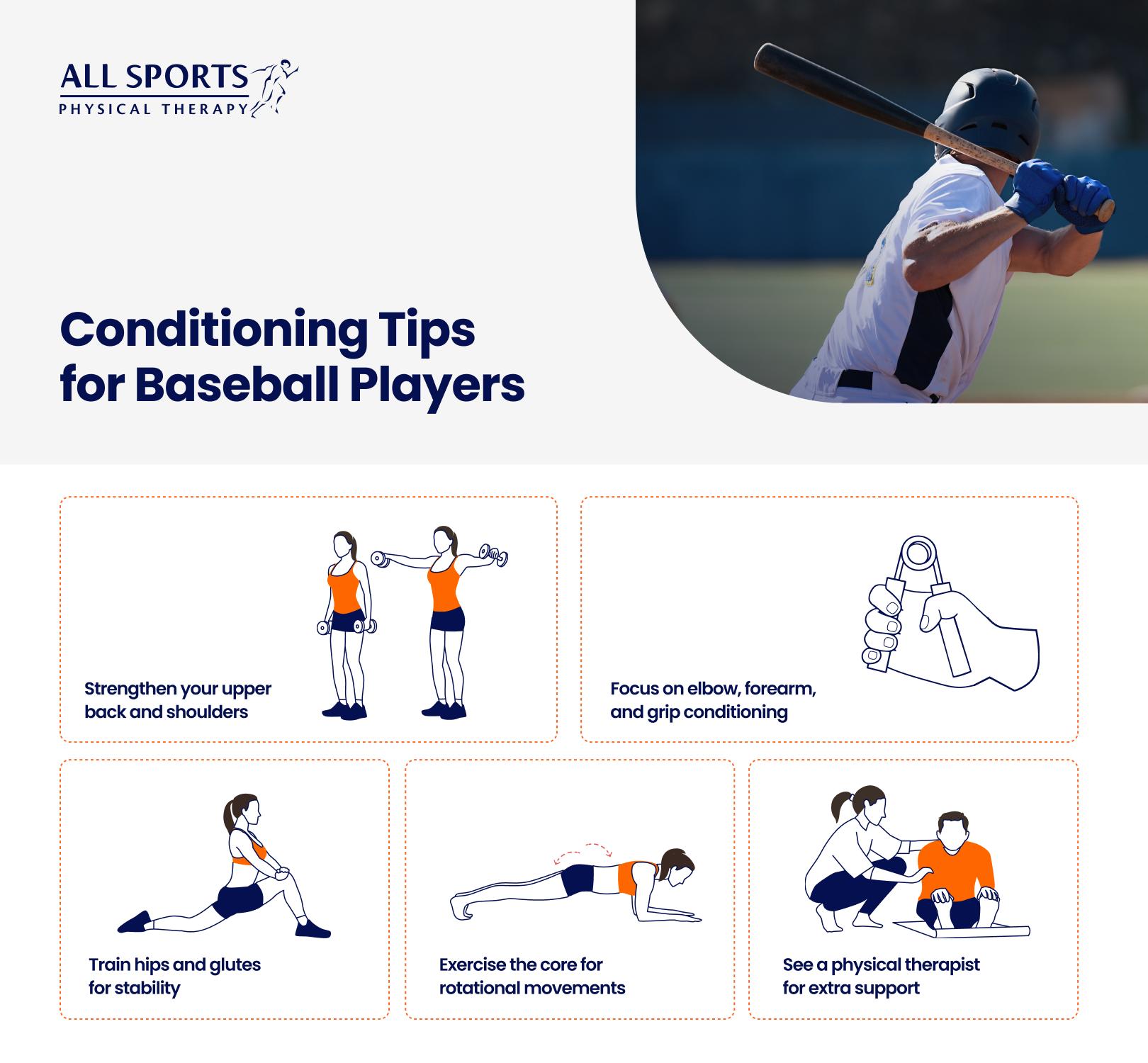
A major aim of baseball conditioning drills is to prevent injury. While any high-level athlete contends with trauma, baseball players are subject to several sport-specific injuries. Common conditions to watch out for:
- Batter’s shoulder. A torn labrum in the back of the shoulder caused by a forceful follow-through on a swing.
- UCL tear. Repeated overhead throwing can rupture the ulnar collateral ligament (UCL) in the elbow.
- Catcher’s thumb. A hypertension of the thumb when receiving the ball; catchers are also prone to lower back strain due to prolonged crouching.
- Hamstring strain. A partial tear of the muscles and/or tendons in the back of the thigh.
- Hand and wrist injuries. Catching balls on high speeds and getting hit by a pitch can lead to hand and wrist fractures and sprains.
- Knee and ankle sprains. Sudden sprints and jumps in the outfield can injure the knee and ankle.
Building a strong throwing and swinging engine
Shoulder health and stability are especially important in baseball. Pitchers, hitters, and fielders all rely on strong, flexible shoulders to throw efficiently, swing with power, and stay durable throughout the season.
During a swing, multiple shoulder muscles activate (especially the posterior deltoid, rhomboids, and traps) to bring the bat through the zone. Meanwhile, throwing engages the anterior deltoid and pectoral muscles. Throughout both movements, the scapula plays a key role in providing stability and control.
To strengthen these muscles and improve shoulder stability, incorporate a mix of warm-ups, control work, and strength-building drills.
Conditioning exercises for shoulder stability
- Long toss warm-up: A controlled progression of longer-distance throws to increase blood flow, improve arm readiness, and gradually build throwing volume before bullpen sessions.
- Rotator cuff exercises (light weights or bands): Strengthens the small stabilizing muscles around the shoulder to support joint control and reduce injury risk (for example, band external rotations).
- Medicine ball throws: Builds explosive upper-body power while training the core and shoulders to transfer force efficiently (for example, rotational throws or overhead slams).
- Shoulder press (proper form): Develops overhead strength and stability, helping support throwing mechanics and shoulder endurance, especially when performed with controlled motion and light-to-moderate weight.
Conditioning the core for power and protection
Whether you’re throwing from the mound or the outfield, strong and accurate throws require more than arm and shoulder strength alone. Relying only on the arm increases stress on the shoulder and elbow, which can raise the risk of overuse injuries over time. Instead, the most effective throwing mechanics generate power from the ground up, using the legs, core, and upper back to create force, stability, and control.
Strong core muscles in the abdomen, lower back, pelvis, and hips allow you to quickly bend and twist to field a ball and make a throw, oftentimes off-balance. A well-conditioned core maintains your balance and provides stability.
To build that combination of strength and control, include a mix of exercises that challenge the core to resist movement (stability) as well as generate movement (rotation).
Conditioning exercises for core strength
- Plank variations (standard, side, shoulder taps): A family of plank holds performed facing the floor, on one side, or with alternating shoulder taps, all designed to challenge the core and shoulders to keep the body steady, level, and aligned under tension.
- Suitcase carry (dumbbell or kettlebell): A single-sided loaded walk that strengthens the core, grip, and hip stabilizers while training the body to resist leaning or twisting.
- Standing anti-rotation chop (cable or band): A standing cable or band movement where the arms pull across the body while the torso stays square, training the core to resist unwanted rotation and maintain control through the midsection.
Training the legs for sprinting and sudden movements
Baseball players may not run long distances, but nearly every play demands quick acceleration, sharp stops, and sudden lateral movement. Fielding a ground ball, tracking a fly ball, or stealing a base all require fast reactions and powerful bursts, often in unpredictable directions. Strong hamstrings, calves, and glutes help support those split-second movements and reduce the risk of strains and lower-body injuries.
To build speed and agility on the field, focus on drills that train both explosive acceleration and change-of-direction control.
Conditioning exercises for agility
- Resisted sprints (sled pulls or bands): A short sprint performed with added resistance—typically a light sled dragging behind or a band providing backward pull—so each stride requires more force and reinforces powerful acceleration.
- Agility ladder drills: A series of fast footwork patterns through a flat ladder on the ground, designed to sharpen coordination, rhythm, and body control while the feet move quickly and precisely.
- 3-point starts: A sprint start from a low stance with one hand on the ground, emphasizing an explosive first step and strong forward drive to mimic game-like bursts out of a stationary position.
Warm-up and recovery routines that matter
As with any intense exercise, what you do before and after sets the stage for a productive workout and recovery. Plan your pre- and post-routine just as you would the actual workout with 10-15 minutes of warm ups to loosen muscles and joints:
Mobility exercises
- Neck rolls
- Arm circles
- Wrist and ankle rotations
- Torso twists
- Gentle bodyweight or band exercises (glute bridges, planks)
Dynamic movements
- Walking lunges with a twist
- High knee lifts
- Short sprints
- Side shuffles
Recovery basics to cool down
- Light jogging
- Stretch hamstrings and quads
- Hydrate
- Replenish lost protein with a snack (yogurt, banana, peanut butter)
- Build in rest days during conditioning program
- Get adequate sleep
In-season vs. off-season conditioning
Baseball workouts change dramatically as you move from the off-season to spring training and then into the long game schedule. Each step will have different conditioning goals.
- Off-season focus: Build strength, power, and agility.
- Pre-season. Transition strength training into sport-specific speed and ratchet up throwing volume.
- In-season focus: Maintain strength and arm health with modified workouts. For example, performing horizontal pulling (rows) instead pull-ups to lessen elbow strain.
Position-specific conditioning
A baseball team consists of several position players. Each demands a different conditioning regimen.
- Pitchers: Prioritize shoulder endurance, hip mobility, and lower-body strength.
- Catchers: Emphasize hip/ankle mobility, squat endurance, and low-back resilience.
- Infielders and outfielders: Focus on lateral speed, accleration/deceleration, and throwing.
- Hitters: Build rotational power and front-hip stability.
When to see a physical therapist
Once your baseball conditioning gets into gear, you don’t want anything to delay your return to the diamond. Yet there may be times when you need to pause and see a physical therapist for advice. The sooner you take care of even minor discomfort, the sooner you can get back to the sport you love.
Consider seeing a physical therapist if you experience:
- Shoulder or elbow pain lasting more than a few days
- Sudden loss of velocity, control, or stamina
- Repeated hamstring, groin, or hip pulls
- Persistent back or hip tightness
Play ball with All Sports Physical Therapy
A well-rounded baseball conditioning program builds strength, improves mobility, and helps lower the risk of injury throughout the season. The team at All Sports Physical Therapy can help you prepare for spring training, improve your mechanics, and stay healthy all year long. Contact us to get started.
FAQs
What are the most important conditioning priorities for baseball players?
Baseball conditioning focuses on improving core and leg strength, building agility for quick movements, and developing endurance for a long season. A well-designed program also protects key joints like the shoulder, hips, and elbow.
How often should pitchers do arm-care exercises?
Pitchers should typically perform arm-care and strengthening exercises 3–4 times per week in the off-season. In-season, volume is adjusted based on game schedule, but arm-care routines are often maintained 2–3 times per week, depending on workload and fatigue. A trainer or physical therapist can help manage this safely.
What’s the best way to prevent shoulder and elbow injuries?
Practice perfect throwing mechanics. That means not letting your arm take the full force of the throw. Instead, build up the lower leg muscles and the midsection to lift the pressure off the shoulder when letting go of the ball. Always warm up before a game and stretch the muscles of the shoulder and forearm.
Should baseball players lift heavy in-season?
Yes, but at a modified volume. Many athletes benefit from heavier lifting with fewer reps. Horizontal pulling exercises (rows) are often preferred over frequent pull-ups to reduce elbow strain.
How do I know if I’m throwing too much?
Distinct signs you’re overtraining or overthrowing as a pitcher include:
- Ongoing arm soreness
- Excessive fatigue
- Drop in velocity and control
- Failure to recover after a game
Talk to your trainer or physical therapist about what to do to reverse course. You may also benefit from:
- More sleep and rest
- Temporarily reducing intensity
- Rechecking mechanics
- Increasing protein intake for muscle recovery